✒️ :. MOHD ISHAQ SHAH
Introduction: Recent budget session of Jammu and Kashmir Legislative Assembly has revealed some stunning facts about the employment scenario in Jammu and Kashmir and the tendency of our government towards it. Govt’s indifferent approach towards unemployed youth, Social pressure, market demands and psychological sphere of the unemployed world are some of the core issues that I am going to highlight here in this write up. I would like to maintain a balance between the facts and fictions that are floating in the air of our state. Introduction of SASCI and its future implications are worth mention here to prove the point of argument in motion or against the motion. This budget summary shows nothing special about the overall development of the state in terms of employment generations, fight against chronic diseases, farmers , traders etc .Yes, it has allocated funds to different programmes that have not too much importance in UT’s overall development. There is no clear cut indication for regularization of Ad-hoc, need base, contractual employees, SPOs, NYS, daily wagers of different departments etc. there is no clear cut policy for filling up vacancies on a regular pattern like the central govt departments execute recruitments on regular basis after a gap of 1,2 or 3 years. There is no increase in old age, widow pension. There is no financial assistance to unemployed youth for the survival until they become economically independent. There is no loan waiver to KCC holders, transporters and other industrial sector loan holders which would have given a hope to the people of Jammu and Kashmir. There is developmental fund for basic rural infrastructure. Agriculture and horticulture sectors have been totally ignored.
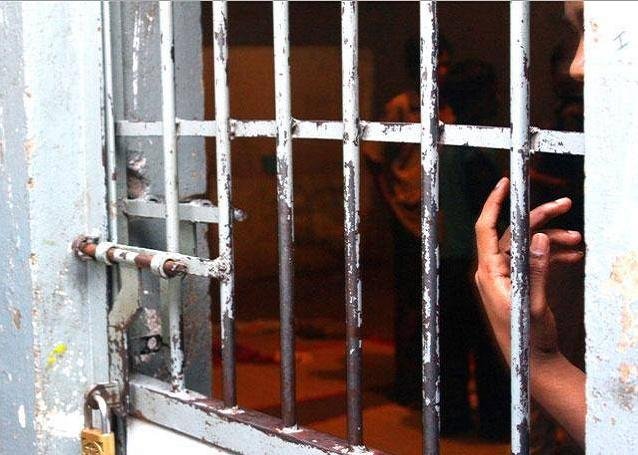
Current Employment Scenario: current employment scenario of Jammu and Kashmir is very pitiable and the recent unemployment index report has placed Jammu and Kashmir as the state with highest unemployment rate of 6.7% that is very alarming for the future of the state. The very fresh budget session of the Assembly of Jammu and Kashmir revealed some alarming facts. A report of Greater Kashmir on Feb 09, 2026 reads : The Jammu and Kashmir Government on Monday informed the Legislative Assembly that the Union Territory’s overall unemployment rate currently stands at 6.7 per cent, which is significantly higher than the national average of 3.5 per cent. The information was shared in a written reply to a starred question raised by MLA Mubarak Gull, the government stated that as per the Periodic Labor Force Survey (PLFS), the unemployment rate among persons aged 15 years and above in J&K has shown fluctuations over the past few years, remaining consistently above the national average. The House was further informed that a baseline survey was conducted across the Union Territory by the Employment Department in collaboration with the Union Territory Administration under Mission YUVA.
The survey identified 4.73 lakh individuals in the age group of 18–60 years, out of which around 46.8 per cent reported that they were “not working but willing to work”, highlighting the magnitude of employment challenges, particularly among the youth.
Replying to questions regarding steps taken to address unemployment, the government said that employment generation, especially among youth, remains a top priority. It clarified that the focus is not only on short-term job provisioning but on creating sustainable livelihoods by encouraging youth to become job creators rather than job seekers.
In this context, Mission YUVA was highlighted as a transformational initiative aimed at promoting entrepreneurship across Jammu and Kashmir. Since its launch, the mission has witnessed a strong response, with around 70,000 applications received on the YUVA platform, reflecting growing interest among youth in enterprise-led employment. Out of these, Detailed Project Reports (DPRs) for nearly 52,875 applicants have been prepared through Small Business Development Units (SBDUs). Following scrutiny by banks, about 47,816 applications were examined, of which 16,141 cases have already been sanctioned. The government said around 9,500 applications has been rejected, largely due to eligibility and credit-related issues, while the remaining cases are at various stages of completion. The government further informed that sanctioned beneficiaries have been provided handholding support, training and mentoring. So far, more than 7,300 entrepreneurs have completed training, while several others are currently undergoing capacity-building programmes….
So for as SASCI is concerned,it is an interest free loan provided by center govt to states for infrastructural development in tourism sector. The SASCI (Special Assistance to States for Capital Investment – Development of Iconic Tourist Centers to Global Scale) scheme, launched by India’s Ministry of Tourism in July 2025, funds the development of major tourist sites to global standards. It provides 100% central funding for infrastructure, improving the end-to-end tourist experience and boosting local economies.
Key Aspects of the SASCI Scheme:
Objective: To transform selected tourist sites into world-class destinations with top-tier infrastructure, connectivity, and sustainability measures. Funding & Duration: The central government provides full funding for selected projects, with implementation responsibility resting with state governments, aiming for completion within roughly two years. Focus Areas: Projects focus on enhancing the entire tourism value chain, including accessibility, sanitation, and sustainable operation and maintenance. Scope: The scheme, active as of early 2026, aims to promote both domestic and international tourism through enhanced infrastructure. As of September 2025, 40 projects worth over Rs 3,200 crore have been sanctioned under this initiative.
Analyzing all the three components of the article let me say that the theories projected by our govt. seem to be hypothetical. The most stunning facts revealed in the assembly session are that in last two years our govt received a fee of worth 48.88 crore from the unemployed youth of our land who are falsely promised that they will be waived off the fee of the application forms. This is not just a guess, but a fact revealed to the question raised by Waheed-UR- Rehman Parra by the concerned ministry. How can we expect a job policy from the govt that is hell bent on collecting such a huge amount from unemployed youth?
When the funds already available with the govt remain unutilized, what is the is the fun of taking loans under SASCI for a period of 50 years that too without any concrete planning. SASCI aims at achieving the target of developing tourism sectors and making certain tourism sites at par with international ones. How come it possible that the money meant for tourism development can be utilized for other sectors. As per MOU is concerned that will require our state to invest the funds on the particular sector they are meant for. And our govt is accountable to center for the utilization of funds. Before getting the loans our govt must have declared the developmental programmes and the expected employment generation after initiating such programmes. So it can surely be said that thus long term loan will put our state into future vidambana. In case the state after a period of 50 years is not able to repay the loan amount, undoubtedly we shall have to sale out our all infrastructure to the center govt and especially to the companies that the center govt would have taken the loans from.
It has often been observed that the funds granted by central govt go lapse due to non utilization as the implementation is hindered by fragile policies and certain demographic factors. In recent past Rs 10 crore granted under RMSA would go lapse due to non utilizations on proper time. According to a statement by Wahid-Ur –Rehman Parra, in the previous financial year only 1200 crore were expended on different sectors while as rest of the funds remained unutilized. Hence, it can be said that the facts and the fictions are not symmetrical here. And it is obvious that the ruling class seems to be ignorant of the future consequences of the present discourse. And the public herself is blindly following the fictions provided in the name of facts.
BUDGET SESSION, UNEMPLOYMENT AND SASCI – FACTS AND FICTIONS
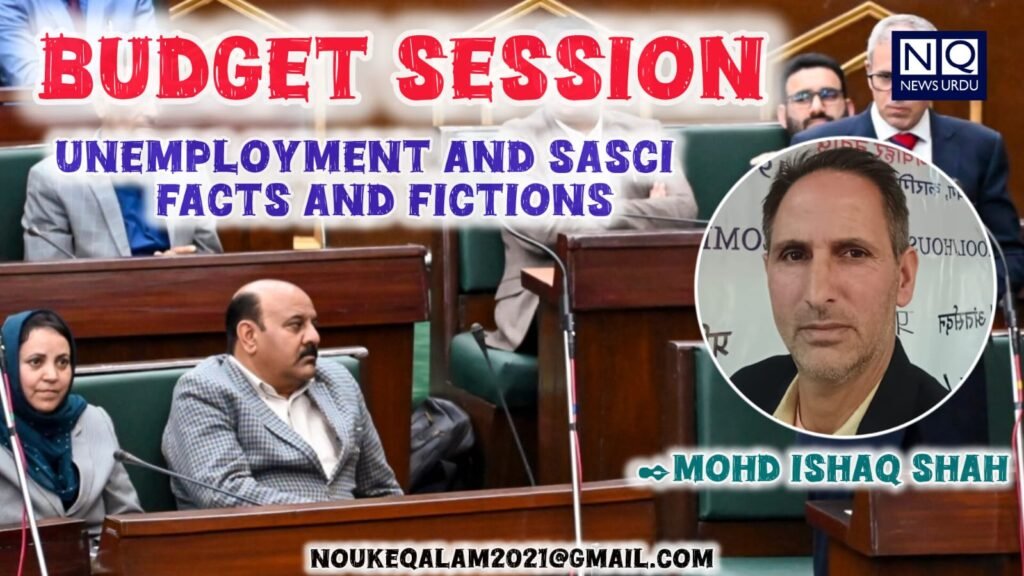
Image source: News API
✒️ :. MOHD ISHAQ SHAHIntroduction: Recent budget session of Jammu and Kashmir Legislative Assembly has revealed some stunning facts about the employment scenario in Jammu and Kashmir and the tendency of our government towards it. Govt’s indifferent approach towards unemployed youth, Social pressure, market demands and psychological sphere of the unemployed world are some of […]