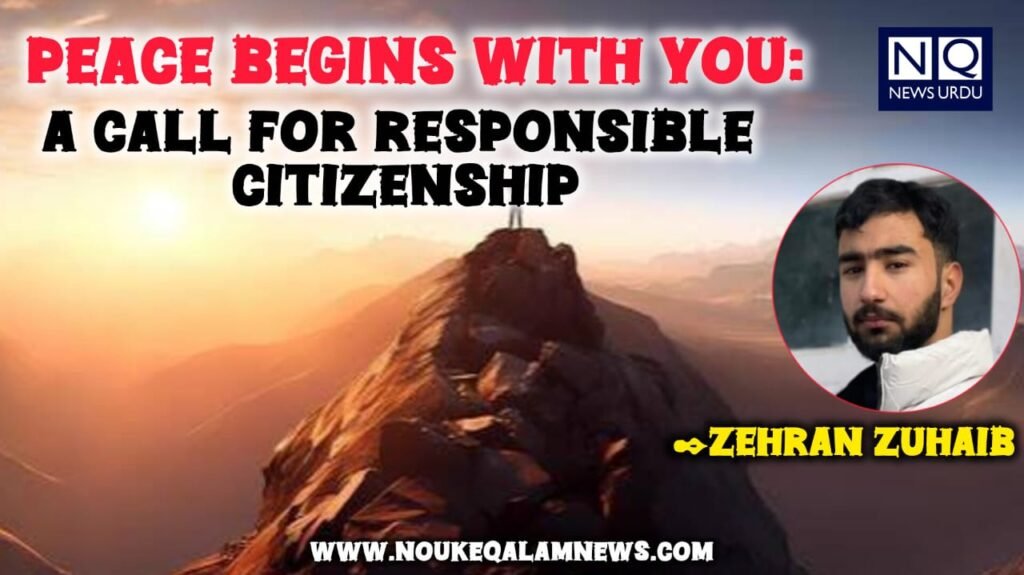
✒️ :. Zehran Zuhaib
Pulwama J&K, April 17: India stands at a critical point where social stability, youth engagement, and national development are closely linked. At a time when global conflicts are rising and internal challenges are becoming more complex, peace must be understood not as an abstract goal but as a daily responsibility shared by every citizen.
Across the world, the nature of conflict has evolved. It is no longer confined to borders or traditional political disputes. Today, tension exists within communities, social groups, and digital spaces. Anger spreads faster through misinformation. Mistrust deepens through division. This shift demands a new approach where peace is built from the ground level, starting with individual behavior.
India reflects both progress and challenge in this context. On one hand, there have been improvements in reducing certain forms of violence. On the other, emerging issues such as cybercrime, youth involvement in violent acts, and social polarization present new risks. Reports indicate that thousands of juvenile crime cases continue to be recorded across the country, with group influence and lack of direction playing a key role in youth involvement.
Violence also impacts development directly. Studies show that exposure to crime and conflict reduces educational outcomes, affects mental health, and limits opportunities for young people. This creates a cycle where instability weakens human capital, and weak human capital further increases vulnerability to conflict.
In regions like Jammu and Kashmir, these challenges carry deeper implications. Prolonged uncertainty has shaped social behavior, community trust, and youth aspirations. Families continue to face insecurity. Young people often navigate between opportunity and risk. In such environments, peace becomes the foundation for any meaningful progress.
At the national level, policy frameworks increasingly recognize this connection. Initiatives aligned with education, lawfulness, and youth engagement are being promoted to strengthen peace building efforts. Programs supported by institutions and international partnerships aim to equip young people with ethical awareness, decision making skills, and a sense of responsibility toward society.
Education stands out as a key driver. Global evidence shows that access to quality education reduces inequality, builds resilience, and prevents conflict. At present, millions of young people worldwide still lack access to education, highlighting the scale of the challenge and the importance of investment in this sector. In India, strengthening education systems and aligning them with values of peace and inclusion remains essential.
However, policy alone cannot ensure peace. Real change depends on how individuals act in daily life. The way people communicate, respond to disagreement, and engage with others directly shapes the social environment. A single responsible voice can reduce tension. A careless action can escalate it.
Youth are central to this transformation. India has one of the largest youth populations in the world. This demographic strength can either drive growth or contribute to instability depending on how it is guided. When young people choose dialogue over confrontation, they reduce conflict. When they reject hate and misinformation, they strengthen social harmony. When they act with discipline and responsibility, they build trust.
Peace also requires clarity. It does not mean silence in the face of injustice. It requires standing for truth, fairness, and dignity through constructive and lawful means. Strong societies are built when citizens are both responsible and aware of their rights and duties.
Practical action is necessary. Investment in education, skill development, and employment must remain a priority. Community level engagement programs must expand. Platforms for dialogue must be strengthened. Youth must be included not only as participants but as leaders in peace building efforts.
Peace is not achieved through a single initiative or policy. It is built step by step through consistent effort, responsible communication, and collective discipline. It requires unity across regions, communities, and generations.
India’s future depends on the choices made today. Stability, growth, and social harmony are directly linked to how individuals and communities respond to challenges.
The message is simple and urgent. Peace is not distant. It is personal. It begins with each citizen.
Peace begins with you.